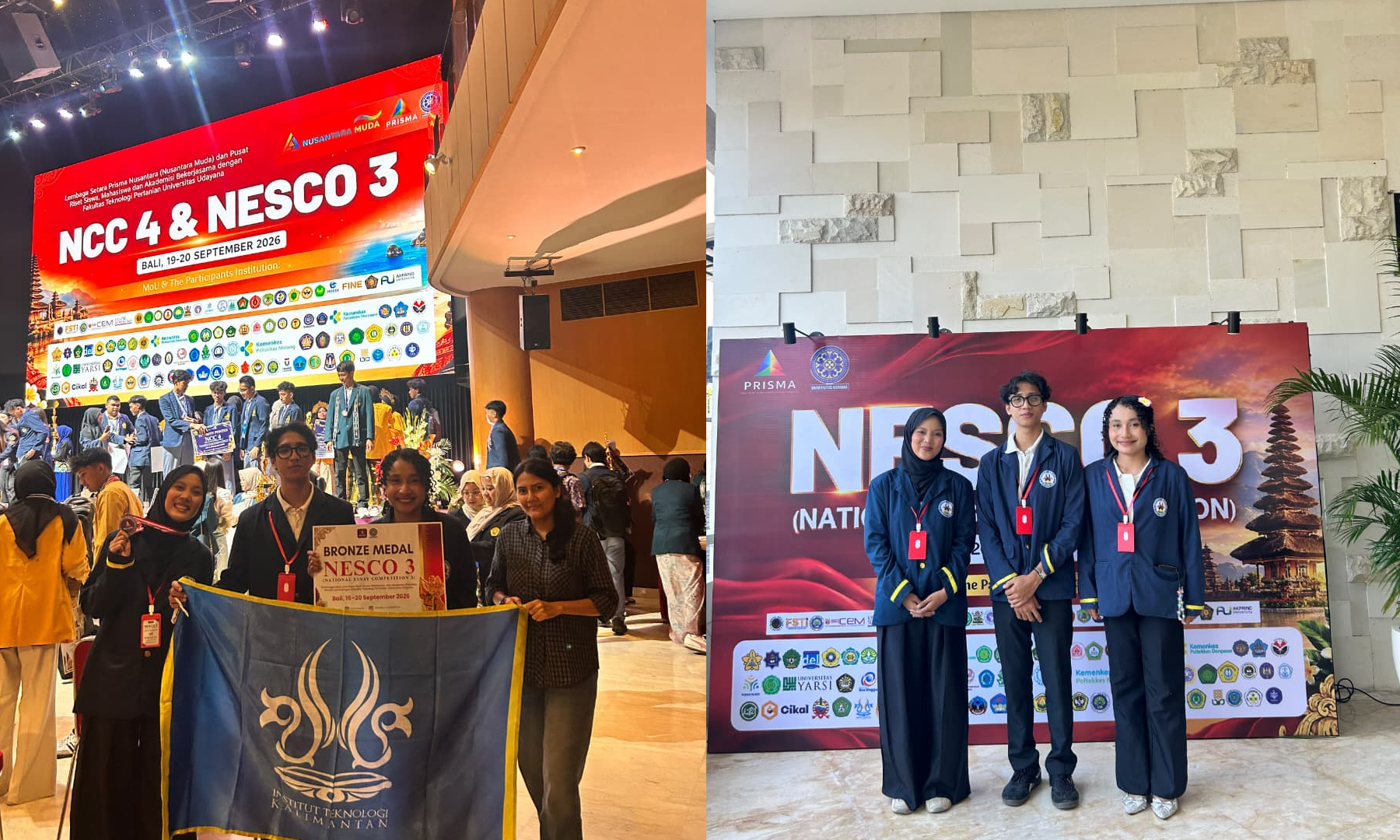
An Information Systems student from Institut Teknologi Kalimantan (ITK) has won a Bronze Medal in the Education Sub-Theme category at the 3rd National Essay Competition (NESCO 3), held in Denpasar, Bali, on September 19–20, 2026. The achievement was earned through an innovative idea entitled “NusaLab: An Interactive Virtual Laboratory to Improve Scientific Literacy and Promote Equal Access to Education in Indonesia.”
The National Essay Competition (NESCO) is a national-level scientific writing competition for high school students and university students from across Indonesia. The competition is initiated by the Pusat Riset Siswa, Mahasiswa, dan Akademisi (PRISMA) as a platform for young people to develop and present innovative and solution-oriented ideas that contribute to national development. For NESCO 3, PRISMA officially collaborated with the Faculty of Agricultural Technology, Universitas Udayana, under the theme “Creating Real Impact through Innovation: The Strategic Role of the Young Generation in National Development.”
NESCO 3 brought together 444 teams and a total of 643 participants from 60 higher education institutions and various secondary schools across 19 provinces in Indonesia. The finalist activities began on September 19, 2026, with the main competition. During this stage, finalists presented their scientific papers and participated in comprehensive question-and-answer sessions with the judging panel. The first day concluded with the announcement of the winners and the presentation of awards to the top-performing teams.
The Bronze Medal-winning team consisted of Muhammad Aqila Ardhi (10231057) from the Information Systems Study Program as the team leader, along with Archangela Adelina (18231015) and Putri Amalia Fitriani (18241063) from the Occupational Safety Engineering Study Program. The team was supervised by Mayati Isabella, S.T., M.T., a lecturer from the Occupational Safety Engineering Study Program at ITK.
The essay presented by the team introduced NusaLab, an interactive virtual laboratory platform designed to support science learning through digital practical simulations. The idea was developed in response to disparities in science education in Indonesia, particularly limitations in laboratory facilities that may hinder practical learning activities and the development of students’ scientific literacy.
NusaLab is designed to enable students to conduct experiments through digital simulations without relying entirely on the availability of laboratory equipment, materials, or facilities at their schools. Through this approach, NusaLab is expected to serve as an accessible supplementary solution for science learning while supporting the improvement of students’ scientific literacy.
In addition to the main competition, the second day of NESCO 3 featured a field trip as a cultural excursion for the participants. The field trip included visits to Melasti Beach and the Tanah Lot cultural heritage area.
This achievement represents one of the contributions made by ITK students in developing innovative ideas to address educational challenges in Indonesia. Through the NusaLab concept, the students not only explored a technology-based solution but also highlighted equal access to and quality of education as important aspects of creating meaningful impact for society.